 Story Circle
Features for readers and writers
Story Circle is two apps in one shell. As a reader you find books that are still being written, follow your own path through them and keep your place; as a writer you lock an open chapter in someone else’s book and write the next piece of it. You can do either without ever doing the other.
The screenshots on this page are from the app as it stands today, and the app’s interface is currently Turkish only — so the labels in the images are Turkish. The caption under each screen explains in English what that screen does.
You can read every book on Story Circle without writing a single line — writing is one way to use the app, not the price of entry.
Finding something to read
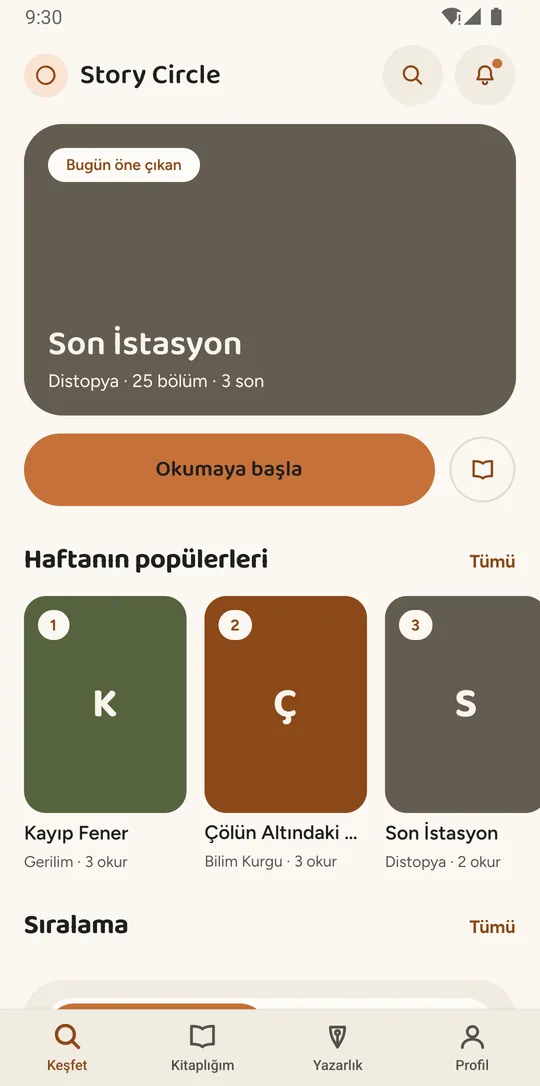
The opening tab is a catalogue of books that are alive: one featured book at the top, then the week’s popular titles and rankings, each with its genre and how many people are reading it. Search and categories are there when you know what you are after.
Because books are written as they are read, what you find is usually unfinished. That is the point — a book you start today may have chapters in it next week that nobody has written yet.
Your own shelf is separate: books you are part-way through, books you started, books you follow, and a note of where you stopped in each one.
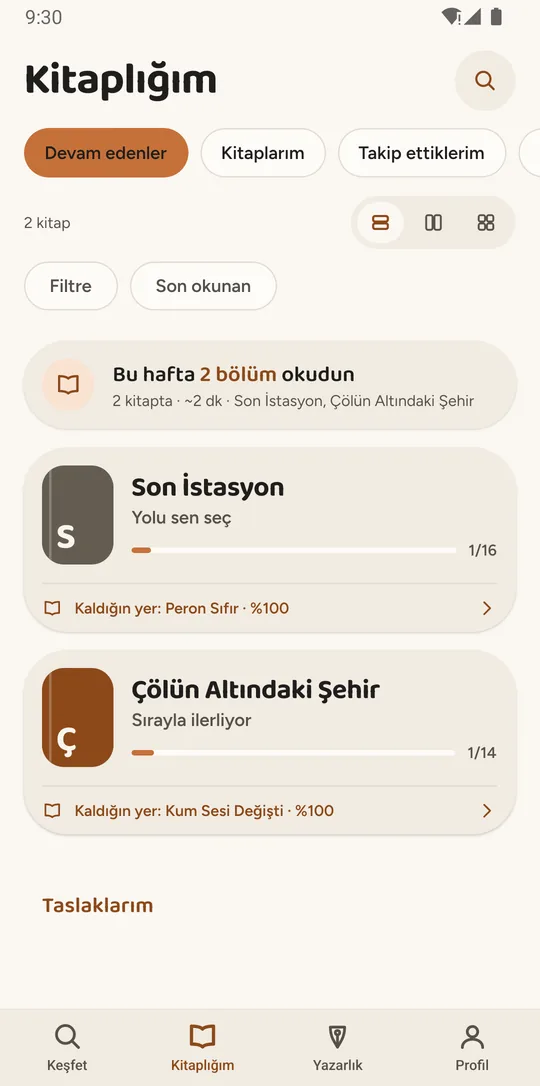
The library is where a half-read book is easy to pick back up. Each book shows how far along the path you are, the chapter you stopped in, and a summary of how much you read this week.
Drafts live here too — including chapters you started writing but did not submit before the lock ran out.
The book page
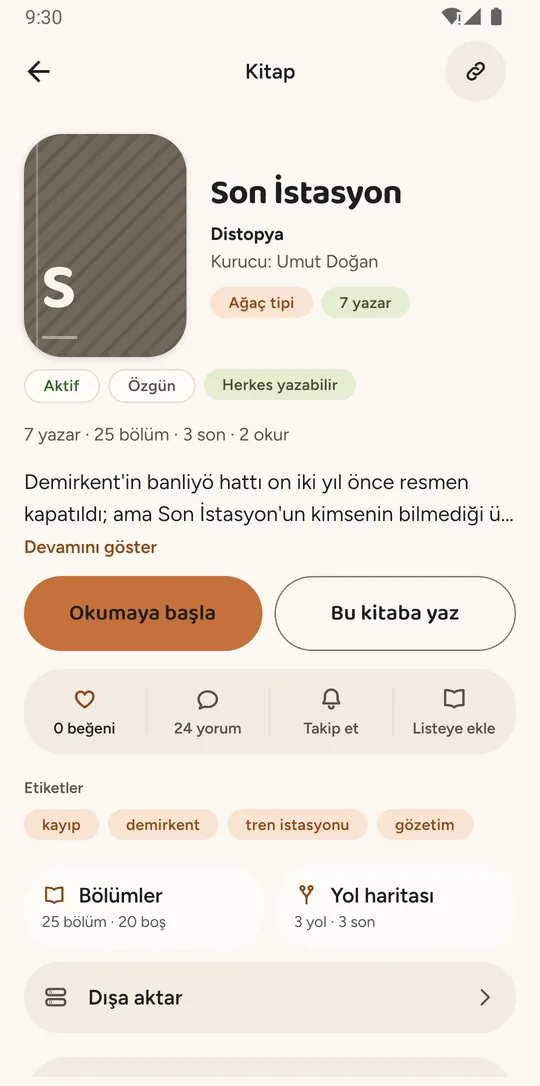
A book page answers the two questions that decide whether you join: what is this, and is there room for me. It shows the premise, the genre, who opened the book, how many authors have written in it, how many chapters exist, how many endings the book has so far, and how many chapters are still open.
Two buttons follow from that: start reading, or write in this book. Whether the second one is open to you depends on the book’s participation mode — some books are open to anyone, in others the owner approves writers.
The rest of the page is the reader’s side: likes, comments, following the book, adding it to a list, and the tags that describe it.
Reading a chapter
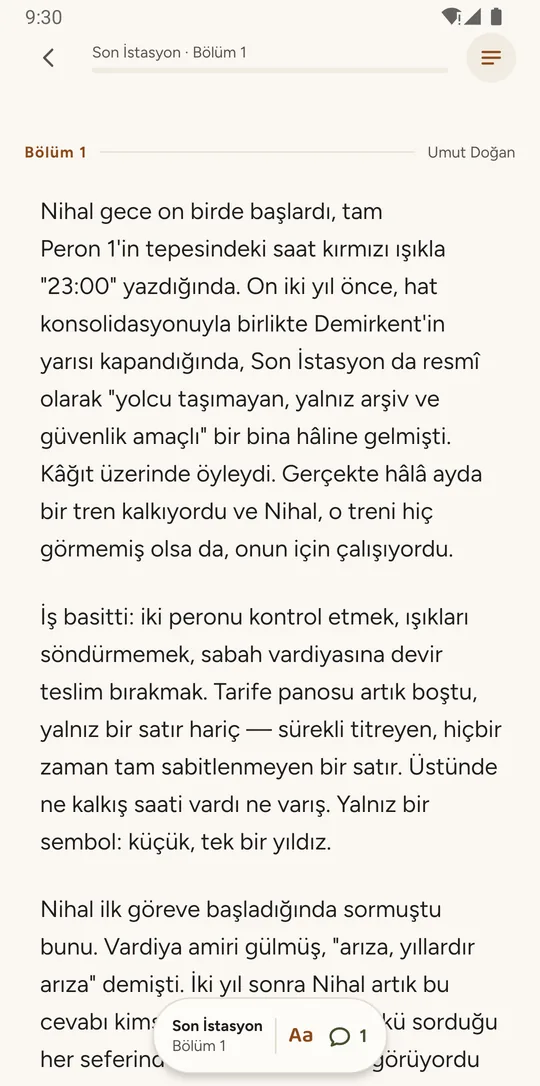
The reading view is deliberately quiet: the chapter, the author’s name, and a progress bar. Text size and reading settings are one tap away and stay as you set them.
Comments belong to the chapter you are reading rather than to the book as a whole, so a discussion about chapter twelve does not spoil chapter three. At the end of a chapter you either continue down the line, or — in a branching book — pick which continuation to follow.
Branching books and the road map
In a branching book the story is a tree, not a line. Several continuations can sit under the same chapter, written by different people at the same time, and a reader who reaches that chapter chooses which way to go. Different paths can end differently.
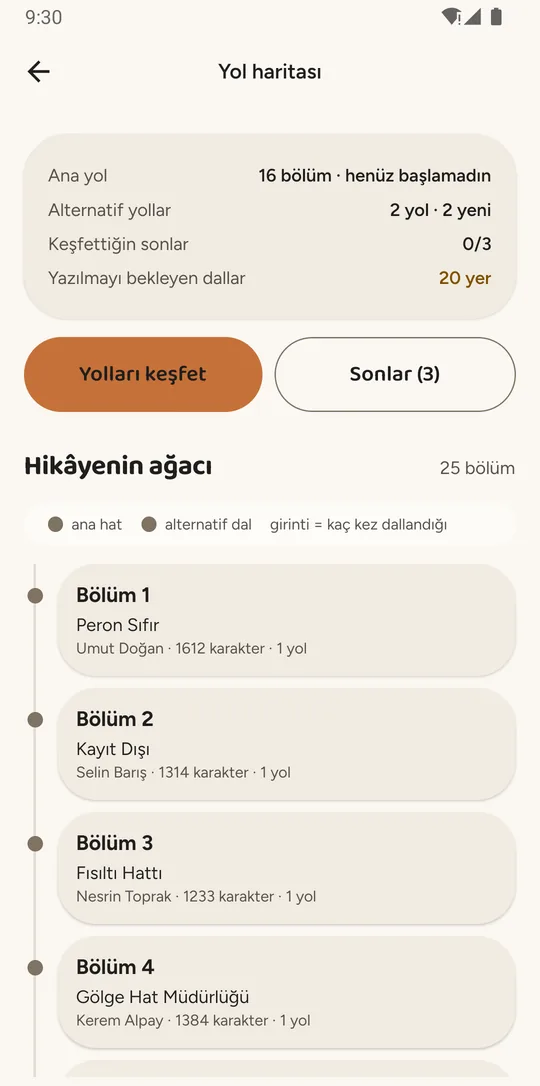
The road map is where that shape becomes visible: how long the main path is, how many alternative paths exist, how many endings you have reached out of the total, and how many branch slots are still waiting for someone to write them. Below it, the whole tree, chapter by chapter, with the author and length of each.
For a writer the same screen is a map of opportunities — every slot marked as waiting is a chapter anyone can lock.
Writing a chapter
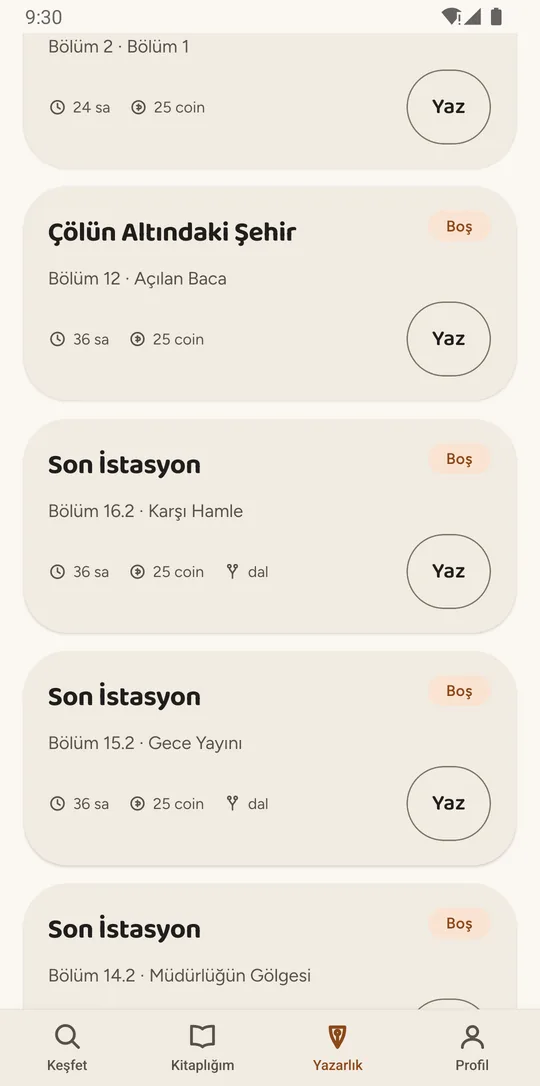
The writing tab collects every chapter that is currently open, across every book you can write in. Each card names the book and the waiting chapter and shows how long its lock lasts, so you can judge before you commit.
Pressing write takes the lock. From then until you submit — or until the lock runs out — that chapter is yours alone, and your draft is saved as you go. Before you write, the book gives you the premise, the story rules, the character list and the chapters above yours, so the continuation fits.
After a chapter is published, changes go through a revision: content review again, plus a check on whether the change breaks the chapters that follow, with the book owner deciding.
Running your own book
Opening a book makes you its owner. You write the first chapter and set the frame everyone else works inside: the premise, the story rules, the characters, how many chapters the book is aiming for, how long a chapter may be, how long a lock lasts, and whether the book branches.
You also decide how people join — anyone, or writers you approve — and you keep the character guide, approving characters other authors propose. Owning a book does not mean approving each chapter: a chapter that passes content review publishes on its own.
A book does not have to run forever. It reaches the chapter count you set, and the chapter written in the last slot of a path ends that path — which is how a branching book arrives at several different endings.
Safety and moderation
Every submitted chapter is checked against the platform content policy before it goes live, in every book. A flagged chapter is not published; its author sees the reason and can either correct it and submit again or appeal for human review.
Alongside that, readers can report a chapter, a comment, a book or a user from inside the app, and block a user. Reports go to platform moderators. Downloading and using the app is free, there are no ads, and your data is not used for advertising.