 Story Circle
How to start writing a book
To start writing a book, first say it in one sentence: who wants what, and what stands in the way. Then decide roughly how it ends, choose how many chapters it will have and how long each should be, and finish the first chapter before you polish it. You need enough decisions for page one, not a full outline.
Last updated:
First books rarely stall for lack of talent. They stall on decisions nobody made. You do not need to know everything before you begin, but a book started without three answers tends to stop at its first hard scene: what it is about, where it is going, and how long it will run.
The first half of this page walks through those decisions. The second half shows how the same decisions are made on Story Circle, where a book is written by a community rather than one author, and some of what the person who sets it up decides stays fixed for the life of the book.
How do you start writing a book, step by step?
Each step is one decision, and the order matters: every answer makes the next one easier.
Say the book in one sentence
Who wants what, and what stands in the way? “A young woman searching for her missing brother finds that the whole harbor town has sworn to stay silent” is a premise. If you cannot write that sentence yet, what is missing is not skill but a decision.
Decide which way the ending leans
You do not need the final scene, only its direction. Will the character get what they want, lose it, or learn they wanted the wrong thing? A book with a direction walks somewhere with every chapter; one without circles in place.
Build your lead around a want and an obstacle
Before the name and the hair color, write down what the character wants and why they cannot have it yet. Readers know characters by the choices they make chasing something, not by their list of traits.
Set the size of the book and its chapters
How many chapters, and roughly how long each? It does not have to be exact, but it should be a range. Without one, a two-paragraph chapter sits next to a seven-page one and the book loses its rhythm. One reading sitting is a good yardstick.
Set a writing rhythm
Make the target time, not pages: twenty-five minutes, three times a week. A page target leaves you in debt after a bad day; a time target does not. Add a finish date too, because a book with no finishing condition does not end, it gets abandoned.
Finish the first chapter before you polish it
The first chapter’s job is to exist, not to be perfect. A voice, a time, a place and a problem are enough. Start inside the problem rather than with background; the rest of the world opens up in the chapters that follow.
Never stop at the end of a chapter
As soon as chapter one is done, write the first sentence of chapter two and stop there. Tomorrow you return to a sentence to finish rather than a blank page. Save revision for after the first few chapters are written.
If step one is where you are stuck, how to come up with story ideas covers ways to produce a premise instead of waiting for one. Step three is expanded in how to create a character: want, obstacle and contradiction.
The minimum you need to start a book is three decisions: what it is about (the premise), where it is going (the direction of the ending) and how long it runs (chapter count and chapter length).
A first chapter written without those three is usually not the book’s opening but a note the writer wrote to themselves.
Do you need an outline before you start writing a book?
You do not need a detailed outline, but you do need the premise, the direction of the ending and a sense of size.
Writers roughly split into plotters, who map every chapter first, and discovery writers, who find the story on the page. Both finish books, and both get stuck in different places. The plotter who makes a finished outline the condition for starting never starts. The discovery writer stops at a scene with no direction and mistakes it for a lack of inspiration.
For most first books the safe middle is not a chapter-by-chapter plan but three fixed points: where it starts, what breaks in the middle, where it ends. You find the road between them while writing; the three points just keep you from getting lost.
How do you write the first chapter of a book?
A first chapter establishes a voice, a time, a place and a problem; explaining the background is not its job.
The most common first-chapter mistake is preparing the reader for the story: the town’s history, the family’s past, the lead’s morning routine. Readers want those things after the problem starts, to understand it. Problem first, explanation later.
A useful test: when the chapter ends, the reader should be carrying a question. “Where is her brother?” “Who wrote the letter?” “Why won’t anyone talk?” The chapter does not answer it; it sets it up. Building scenes is covered in more depth in how to write a story for beginners.
In a shared book, chapter one is a handover. On Story Circle the person who sets up the book writes chapter one, and chapter two will most likely be written by someone else. That writer has nothing to go on but your chapter, so the clearer your decisions, the easier the next one is to write. Ending on a question is not a stylistic choice there; it is the starting point you leave for the next writer.
How many chapters should a book have, and how long should they be?
There is no single right number; what matters is that the book has a size and its chapters stay close to each other in length.
Think of chapter length in terms of one reading sitting. Short chapters get read on a phone, on the bus, in between, and pull the reader into “just one more”; long chapters carry more atmosphere but risk losing the reader halfway. For the chapter count, look at how many major events the story carries: something should change in every chapter.
| Preset | Per chapter | How it reads |
|---|---|---|
| Short | 500–1,500 characters | A few minutes, in one go on a phone |
| Medium | 1,500–4,000 characters | Room to set up one scene properly |
| Long | 4,000–10,000 characters | Several scenes, a slower tempo |
| I’ll enter it myself | Anywhere from 200 to 20,000 characters | You type the minimum and the maximum |
What mistakes do first-time writers make?
Most of them are about working habits rather than prose:
- Revising before finishing. Polishing chapter one for the tenth time looks like progress but keeps the book at one chapter.
- Writing long without knowing the ending. A book with no direction starts circling after a hundred pages.
- Opening with the world instead of the problem. Readers follow a problem, not an encyclopedia.
- Setting a page target. A bad day misses it and the debt piles up; a time target leaves no debt.
- Waiting when you get stuck. Most stuck moments are a missing decision rather than missing inspiration, and waiting does not produce a decision. Our guide on how to overcome writer’s block separates five kinds of block and the fix for each.
How do you set up a book on Story Circle?
The book setup wizard has seven steps, each asking one question; nothing is settled until you confirm on the last one.
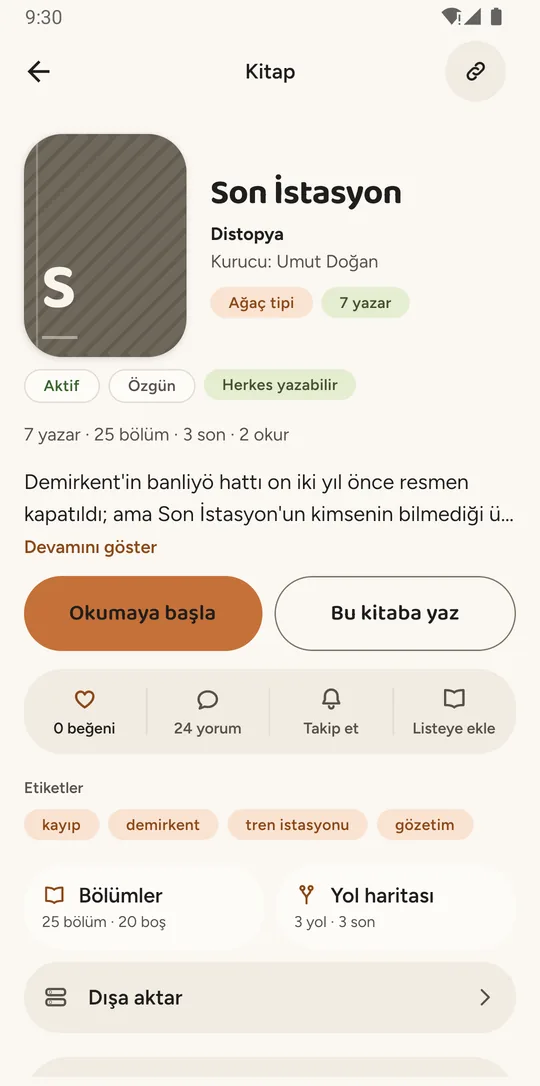
Story Circle is a mobile app where a book is written by a community instead of a single author. The person who sets up the book provides the first chapter, the premise, the rules and the structure; after that, each open chapter is written by whoever starts writing it first.
That makes setup weightier than the first page of a solo book: some of the seven decisions above become binding rules for every writer who joins. A book’s page shows them publicly, so a writer can read the frame before stepping into it.
Template
Short, Medium or Long: you pick how long a book you want and the structure settings fill in to match. All three start as a book that moves along one path. If you already know what you want, “I’ll set it up myself” sits at the top and fills in nothing.
Basics
Title, short description and category. You also choose the work type here, original or fan fiction; fan fiction requires naming the source work. Visibility (public or unlisted) is part of this step too. The cover is not asked; you add it after the book opens.
Story
The premise is a few sentences every writer starts from. This is also where you say where and when the story takes place, which book rules writers follow, and any content warnings. Those three are optional.
Structure
Three questions: How should the story move (one path or branching)? How long should the book be (target chapter count)? What should chapters be like (character range and writing time)? Nothing on this screen can change once the book is live, and the screen says so.
Participation
Can anyone write, or do you approve applicants first? The consecutive-author rule, revision suggestions on published chapters and “Let me see submissions too” are switched on or off here as well.
First chapter
The person who sets up the book writes chapter one, and it has to fit the character range chosen in the Structure step. You can start the character guide here too; characters are optional and can be added later.
Summary
Every decision on one screen, with the SC cost next to your balance. If the balance falls short, the screen tells you before you confirm, and “Save as draft” keeps what you wrote on your device. Confirm, and the book opens.
The Template step is deliberately a shortcut. The Short, Medium and Long cards carry no numbers, because for someone who has not set up a book yet, “how many chapters, how many characters, how many hours” is an equation with four unknowns. The numbers appear in the Structure step, where you can change them.
What can’t you change after setting up a book?
A book’s skeleton is fixed; its appearance and administration are not. The skeleton is anything that would change the rules a published chapter was written under.
| Decision | Once the book is live | Why |
|---|---|---|
| How the story moves (one path or branching) | Fixed | Branching can be neither switched on nor switched off later. |
| Paths per chapter (branching books) | Fixed | The wizard sets it to two: at every fork the reader picks one of two. |
| Fork interval and maximum endings | Fixed | How often the tree forks is decided only at setup. |
| Chapter character range | Fixed | Narrowing it later would put published chapters out of bounds. |
| Writing time | Fixed | Everyone who starts writing relies on the same amount of time. |
| Target chapter count | Grows only | The owner can extend it with SC; it can never be shortened. |
| Main category | Fixed | The shelf the book is discovered on is chosen once. |
| Premise and book rules | Fixed | A writer who joins in month three reads the same frame as the first one. |
| Visibility | Fixed | An unlisted book cannot later be made public. |
| Work type and source work | Fixed | Fan fiction is declared at setup, and the source work is required. |
| Consecutive-author rule | Fixed | One of the rules a writer knows before joining. |
| Book title | Can change | The address stays put, so shared links keep working. |
| Description | Can change | A book can re-introduce itself as it goes. |
| Cover and cover color | Can change | Not asked in the wizard; added after the book opens. |
| Participation | Can change | Open can become approval-required, and back again. |
| Age rating | Can change | Books open as “Everyone”; the rating can rise as the story darkens. |
| Character guide | Can change | Adding a character does not affect chapters already published. |
| Tags | Can change | They steer where the book turns up. |
| Revision suggestions and submission review | Can change | Both switches can be flipped; they bind only what comes next. |
That these settings cannot change is a guarantee rather than a limitation: a writer joining in month three reads exactly what was agreed on day one. If chapter length or writing time could shift mid-book, the ground would move under everyone already writing. The second half of the table is deliberately long, too: title, cover, participation, age rating and the character guide stay in your hands as the book grows.
Should the story follow one path or branch?
A story with one right ending should follow one path; a story that could have several right endings should branch.
One path
The story runs on one track: one chapter is open at a time, and whoever starts writing it first gets it. Chapter one leads to two leads to three, and the book completes itself when it reaches the target.
- Easy to read: one book, one ending.
- Easy to finish: there is only one route to the target.
- One person writes at a time, so the book moves at that chapter’s pace.
Branching
Two different continuations can be written under a chapter, and the reader chooses which path to follow. The same book ends more than once.
- Two writers can work on the same fork at once.
- Disagreement produces two paths instead of an argument.
- Harder to finish: every open path needs its own ending.
Choose branching and the wizard does not ask for a number of paths: every fork has two. Two is the number that makes sense to a reader (“this one or that one”), and it keeps the tree from multiplying open chapters at every depth.
Branching books have two more optional settings: a fork interval (every chapter, or every 2, 4, 6 or 8 chapters) and a maximum number of endings (2 to 16, or no limit). Both are decided only at setup.
Branching can be neither turned on nor turned off later. Where a fork belongs and how many endings to aim for are covered in how to write a branching story.
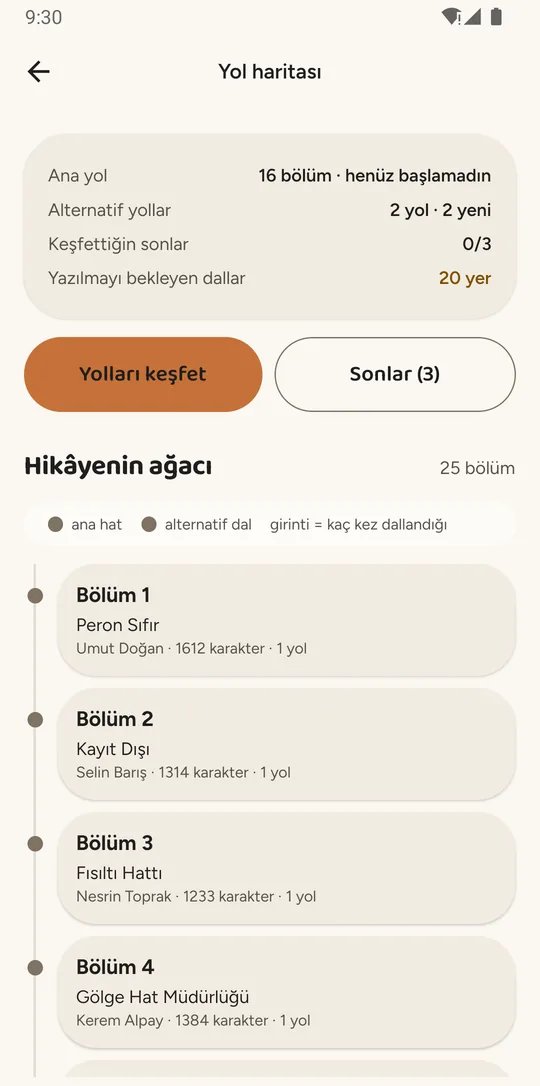
The choice you make at setup is what the reader sees months later on this screen: how many paths exist, which one is the main path, how many endings have been reached, how many chapters are still open.
In a one-path book this screen is a single straight line. The question worth asking before choosing: does this story have more than one right ending?
How many chapters should the book run, and can you extend it?
You choose a target chapter count from 2 to 200, and the owner can later raise it but never lower it.
The target includes your first chapter: a target of ten means the one you wrote plus nine continuations. A one-path book completes itself when it reaches the target. In a branching book every chapter that reaches the target is an ending for its path and nothing can be written under it; the book completes when all open paths have reached their endings or when the owner closes it.
Extending costs SC: at most twenty-four chapters at a time, up to two hundred in total. The cost per chapter rises as the book gets longer and is shown before you confirm. Extending a completed book reopens it for writing. Lowering the target is not possible, because it would leave published chapters beyond it.
Shared books without a finishing condition do not end; they get abandoned. The target is the single number that turns a book into something finishable.
How do you choose chapter length and writing time?
Together they are the book’s tempo: one decides how it reads, the other how fast it moves. Both are settled at setup.
Character range
The wizard offers three presets (Short, Medium, Long), or “I’ll enter it myself” lets you type a minimum and maximum; the app allows a floor of two hundred and a ceiling of twenty thousand characters. The range is a rule, not a suggestion: a chapter outside it cannot be submitted.
Writing time
The longest a writer may keep an open chapter after starting it. The wizard offers five options: 6, 12, 24, 48 and 72 hours, with 24 as the default. When the time is up the chapter opens to everyone again, and whatever was written stays with its author as a draft. A short writing time speeds the book up but leaves slower writers out; a long one does the reverse.
Everyone who starts writing relies on the same length and the same clock, which is exactly why neither can change later. The full cycle from starting a chapter to its publication is on how Story Circle works.
Who can write the book, and who can see it?
- Participation
- In an open book, whoever starts an open chapter first writes it; with approval required, a writer applies and you approve them. Open books grow fastest. This can be changed after the book is live.
- Consecutive-author rule
- Switch it on, and a writer whose chapter was just published has to wait a while (six hours by default) before writing directly under it; in the meantime someone else can write the next chapter. It is off by default. It keeps one writer from taking over the book and makes room for a second voice.
- Visibility
- A public book appears in Discover, search and categories. An unlisted book is reachable only by its link, and writing in it earns neither points nor SC. Visibility is chosen at setup and cannot be changed later.
- Age rating
- Books open with the “Everyone” rating; the wizard does not ask, because a book that has not been written yet cannot be rated. As the content darkens, the owner can raise it to 13+, 16+ or 18+, but never above their own age.
The owner’s authority has a clear edge: the owner cannot rewrite a single word of anyone else’s delivered chapter. A published chapter changes only through the revision flow.
How much SC does it cost to set up a book?
On the current tariff, setting up a book costs 100 Story Coin (SC), and the signup grant for a new account is also 100 SC.
So a new balance covers exactly one book. For the ones after that you earn SC by publishing chapters, signing in daily and reading. The amount appears on the last step of the wizard next to your balance, before you confirm; if the balance falls short the screen says so in advance, and you can save what you wrote as a draft on your device.
SC is an in-app unit only. SC can’t be bought, has no cash value and cannot be transferred. It never buys the right to write a chapter, priority or visibility; it is spent on setting up a book, raising its target and exporting it as a file.
What happens once the book is set up?
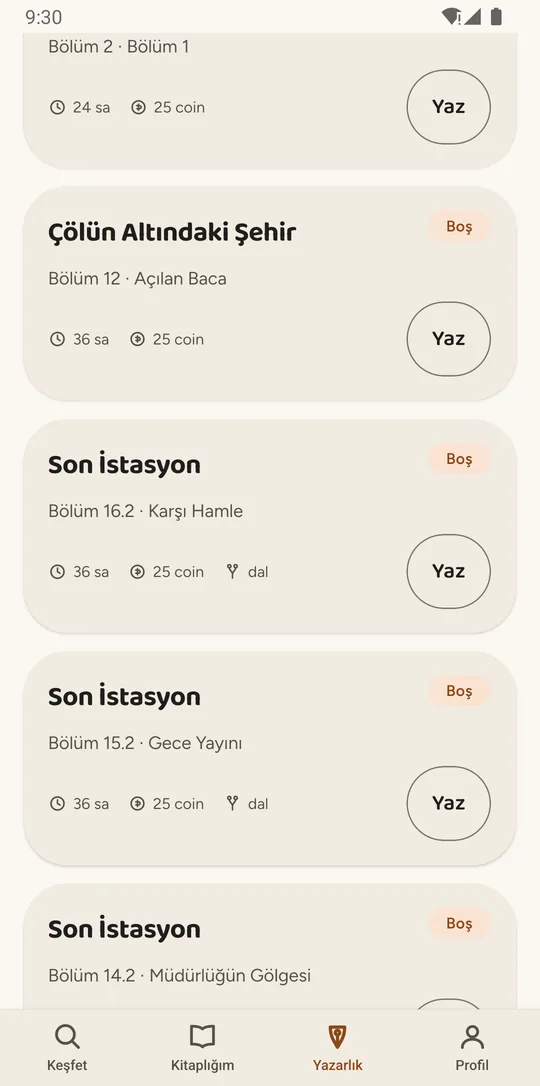
The moment you confirm, the book opens: your first chapter is published and chapter two appears on the open list as an empty chapter slot. From there it is no longer only in your hands: whoever starts writing that chapter first gets a timed writing window to write it.
You handle join requests, the character guide and whether a chapter that breaks the book’s rules stays. What you do not do is approve chapters: a submission goes through automatic content review before publication and publishes on its own if it passes.
A book’s authors are everyone who has written a chapter in it. You can set up a book and never write another chapter, and the book still gets written.
Questions about starting a book
How do I start writing a book with no experience?
Start by saying the book in one sentence: who wants what, and what stands in the way. Then decide which way the ending leans and finish the first chapter before you polish it. What costs first-time writers the most time is not writing but trying to plan everything before writing; you need enough decisions for page one, not a full outline.
Do I need an outline before I start writing a book?
No. What you need is three decisions: the premise, the direction of the ending and the size of the book. Some writers outline every chapter and some discover the story as they go, and both finish books. A discovery writer who gets stuck is usually missing a single decision about what changes by the end of the scene, not an outline.
What should the first chapter of a book do?
Establish a voice, a time, a place and a problem. Starting inside the problem hooks the reader faster than background does. On Story Circle the person who sets up the book writes chapter one, and that chapter is everything the next writer inherits: the voice, the setting and a problem to carry forward.
Can I switch a Story Circle book from one path to branching later?
No. How the story moves is one of the structure settings fixed at setup, and branching can be neither switched on nor switched off afterwards. Turning it off would make written paths unreachable; turning it on would change the terms for everyone who joined a one-path book. If you want a branching book, decide at setup.
Can I change the target chapter count after the book is live?
You can only raise it. The book owner can extend the target with SC: at most 24 chapters at a time, up to a ceiling of 200. It can never be lowered. Extending a finished book reopens it for writing. The cost per chapter rises as the book gets longer, and the exact amount is shown before you confirm.
How much SC does it cost to set up a book on Story Circle?
On the current tariff, 100 SC, and a new account receives 100 SC on signup, so your first book is covered exactly. After that you earn SC by publishing chapters, signing in daily and reading. The amount is shown next to your balance on the last step of the wizard, before you confirm. SC can’t be bought and has no cash value.
Can I make my book public after setting it up as unlisted?
No. Visibility is chosen at setup and cannot be changed afterwards. An unlisted book is reachable only by its link, does not appear in Discover, and writing in it earns neither points nor SC. If you want the community to write the book, set it up as public.
Do I approve each chapter after setting up the book?
Not by default. A submitted chapter goes through automatic content review before publication and, if it passes, publishes without anyone’s approval. You can switch on “Let me see submissions too”, and then a chapter that passed review reaches you first. That switch can be turned on or off at any time.
Related pages
Collaborative writing
The ways a book gets written by a group, and what to agree on before starting one.
What is fan fiction
If your book is set in someone else’s world: the form’s conventions and declaring the source work.
Book writing app features
The tools you have as the owner of a book, plus reading and export.