 Story Circle
Collaborative writing: how to write a book together
Collaborative writing is any way of producing one text with more than one author. In fiction it almost always comes down to two questions: who writes the next part, and what happens to a part once it is written. Groups that answer those two questions finish books; groups that leave them implicit usually stop after three chapters.
This page describes the models people actually use — round-robin, voting, open editing and branching — what each one is good at, and where each one tends to stall. It ends with the model Story Circle uses, which is a fifth option: the first writer to start an open chapter locks it.
The most common failure in collaborative fiction is not bad writing. It is a story waiting on one person who has gone quiet.
Every model below is really an answer to the same question: what happens when the person whose turn it is stops showing up.
How groups usually divide the writing
Round-robin (turn order)
Writers agree on an order and each takes a chapter in sequence. It is the easiest model to explain and the easiest to run in a group chat.
- Good at: even participation, a single clear timeline
- Stalls when: it is someone’s turn and they are busy, on holiday, or simply out of ideas — the whole book waits on one person
- Usual repair: a deadline, then a hand-over rule, then a second hand-over rule, and eventually a spreadsheet nobody reads
Voting
Several writers submit a version of the next chapter, or several directions are proposed, and the group votes on which one becomes canon.
- Good at: keeping quality up, giving readers a say
- Stalls when: turnout drops. A vote needs a quorum, and every round costs the group more attention than the last
- Side effect: the safest option usually wins, because it is the one fewest people object to
Open editing
Everyone can write anywhere, wiki-style, usually in a shared document. No permission needed, no order at all.
- Good at: speed, and very small groups who talk constantly
- Stalls when: two people write the same scene at once, or one person quietly rewrites another’s chapter and nobody wants to raise it
- Side effect: authorship becomes unclear, which makes rights and credit awkward later
Branching
Instead of one canonical next chapter, several continuations can exist under the same chapter, and the reader chooses a path.
- Good at: nobody is ever blocked — disagreement produces two branches instead of an argument
- Stalls when: the tree grows without a shape. Endless branches with nothing marked as the main path are hard to read
- Needs: a branch limit and a visible main path, or it becomes a pile of fragments
The fifth model: whoever starts first, writes.
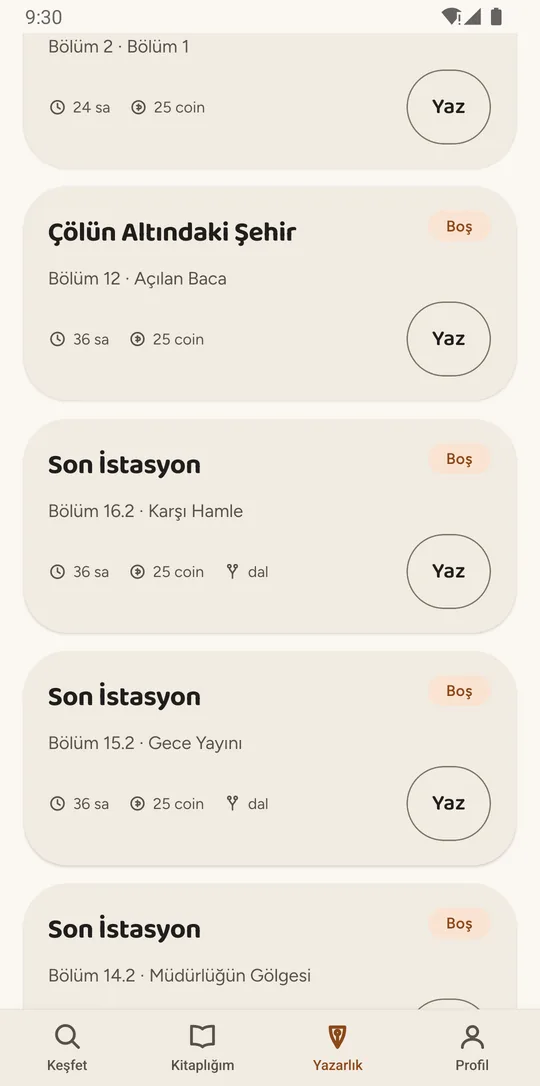
An open chapter belongs to nobody until someone begins. The first writer to start locks it, and for the length of that lock the chapter is theirs alone. If they submit, the chapter goes to review and then publishes. If the lock runs out, the chapter opens to everyone again and their text stays with them as a draft. No turn was skipped, because there were no turns.
This is the model Story Circle uses, and it exists specifically to remove the waiting. A writer who wants to contribute today never has to ask whether it is their turn: they open the book, find a chapter marked open, and start. A writer who goes quiet costs the book one lock duration, not the project.
It also removes the most uncomfortable conversation in shared fiction — telling someone their chapter is not good enough. Nobody approves a chapter. A submitted chapter is checked automatically against the platform content policy, and if it passes, it publishes on its own.
How to start a book with other people
This works whether you use an app or a shared folder. The order matters more than the tools.
Write the first chapter yourself
A premise is not enough to write against. One finished chapter gives everyone a voice, a tense, a setting and a problem to inherit. It is the single highest-leverage thing the founder does.
Name the characters and say what they want
A shared cast prevents the most common wreck: two writers using the same name for two different people. One line each — what they want, and what they will not do — is worth more than a page of backstory.
Write down the narration rules
Tense, person, and how much time a chapter may cover. Three rules that everyone can remember beat twenty that nobody reads.
Decide who may write next — explicitly
Open to everyone, or only to writers you approve. Both work. What does not work is leaving it unsaid until the first disagreement.
Decide whether the book branches
A single line is easier to read and easier to finish. A branching book is harder to finish but survives disagreement, because two people who want different things both get to write. If it branches, set the branch limit now.
Set a target length
A book without an ending in sight loses writers. A number — sixteen chapters, thirty — turns a hobby into a finishable thing.
Publish the second chapter as soon as it lands
Momentum is the whole game. A chapter that sits waiting for approval teaches everyone else that contributing is slow.
What stops a shared book falling apart
Multiple authors do not automatically produce an incoherent book. Missing structure does. Four things carry most of the weight.
A shared cast
Characters are defined at the book level, not invented per chapter. Everyone writes the same people.
An owner, not an editor
The person who created the book handles join requests, characters and revision requests. They cannot rewrite another author’s delivered text — which is exactly why writers are willing to contribute.
Revisions with a rule
A change to an already published chapter is checked against whether it breaks the chapters that follow it, then decided by the book owner.
Review before publishing
Every submitted chapter passes automatic content review before it goes live, so an open book does not mean an unmoderated one.
What collaborative writing looks like in practice
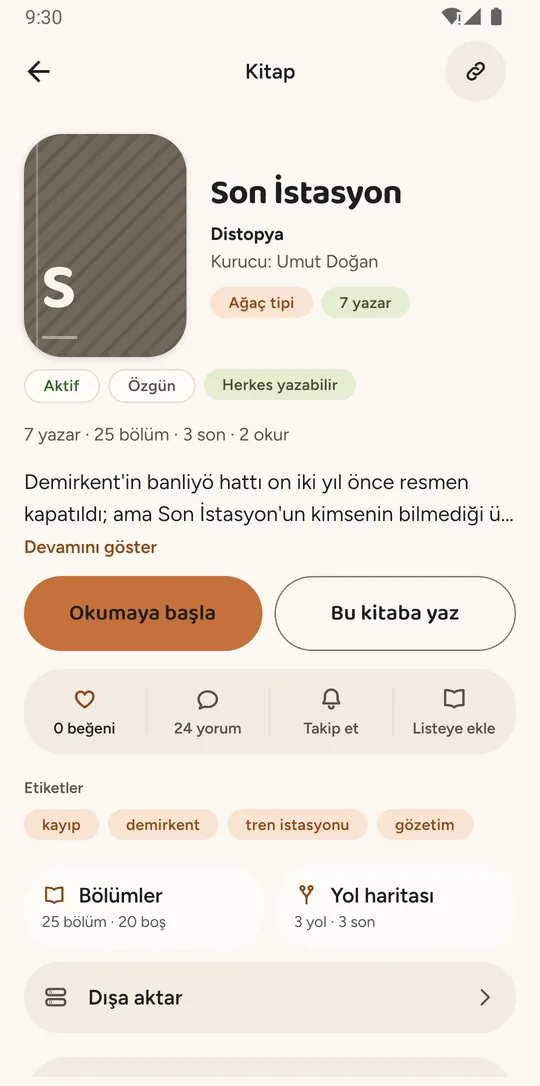
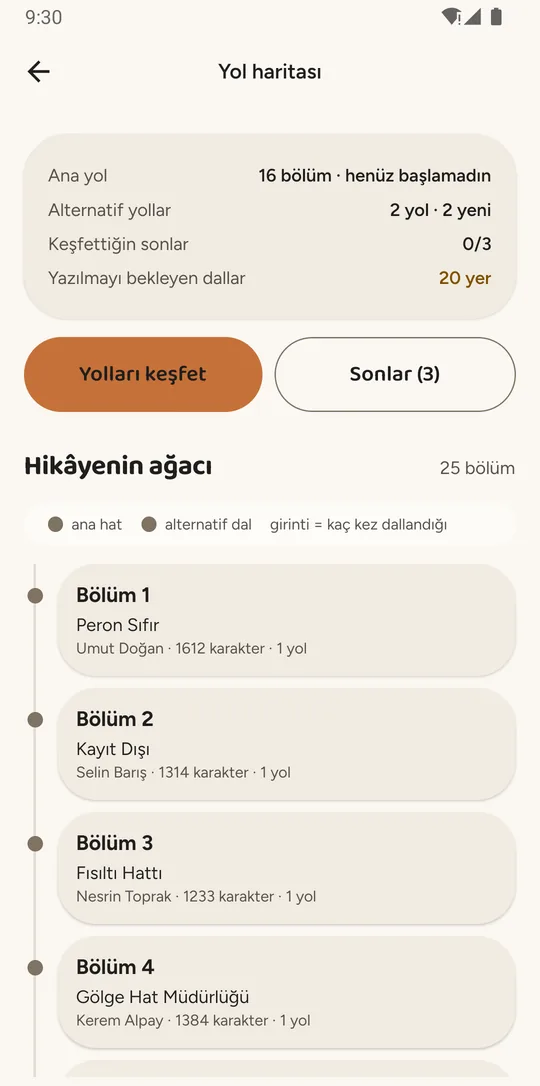
Screens from the Android app. The interface is in Turkish — an English interface is not available yet — so the captions describe what each screen shows.
Frequently asked
What is collaborative writing?
Collaborative writing is any way of producing one text with more than one author. In fiction it usually means a shared story that several writers extend chapter by chapter, each writing their own part rather than editing everyone else’s.
How do you write a book with friends?
Agree on three things before you start: the premise and the characters, who is allowed to write next, and what happens to a chapter once it is published. The second one is what most groups skip, and it is the one that stops the project.
How does Story Circle decide who writes the next chapter?
Whoever starts first. An open chapter is locked by the first person who begins writing it, and it stays theirs until they submit or the lock expires. There is no queue, no turn order and no vote.
What happens if someone locks a chapter and disappears?
The lock has a fixed duration. When it runs out the chapter opens to everyone again, and the text written so far stays with that author as a private draft. Nobody else has to wait for them.
Can two people write different continuations of the same chapter?
In branching books, yes. Several continuations can sit under one chapter up to the branch limit the book owner set, and readers choose which path to follow.
Related pages
Interactive fiction
Branching stories: the shapes they take, and how a reader-chosen path is built.
How to write a story
Scene, want and obstacle, first lines, dialogue, and what to do when you are stuck.
What is Story Circle?
The short version: Android, free, no ads, launching soon.