 Story Circle
Interactive fiction
The main kinds of interactive fiction, a short history of the form, and the shapes a branching story can take.
To write a branching story, build a short single-path trunk first, then fork only where the character stands to lose something. Limit how many paths a fork opens and how long a branch may run, write choices as intentions, keep each branch’s facts separate, merge with a trace or run to an ending, and close every path cleanly.
This guide is for the person about to write one. Every step moves the same example forward: Mina, a courier carrying a sealed envelope through a city-wide blackout. If you want the form itself — where it came from and the kinds it takes — the guide to interactive fiction covers that; this one stays on the writing side.
Last updated:
A branching narrative is a story where the reader chooses at certain points and the choice genuinely changes what follows.
Trunk, fork, limits, choices, branch cards, merges and endings: each step is a decision that keeps the tree from growing faster than it can be written.
Before the first fork, readers need to know who wants what and what is at stake. A few chapters on one path give the branches ground to grow from; stories that fork on page one rarely give any path enough room to deepen.
Example: The first three chapters stay on one path: a city-wide blackout, a sealed envelope addressed to the mayor, and Mina, a bicycle courier, realizing the sender is her missing brother.
Test a candidate fork with three questions: will the two paths still produce different scenes three chapters later, can the reader see what they are giving up, and is there someone to write this branch? If any answer is no, you have one road, not two.
Example: “Left street or right street?” is not a fork. “Deliver the envelope unopened, or read what her brother wrote?” is: each option costs Mina something.
Fix two numbers up front: how many paths a fork opens and how many chapters a branch may run. Limits agreed in advance cause no arguments later, and they stop the tree from growing faster than anyone can write it.
Example: Two paths per fork, a fork every four chapters. A branch runs three chapters at most; on the fourth it either rejoins the trunk or reaches its own ending.
Readers should choose what they are willing to risk, not which way to walk; what happens next is still yours to write. An option that states intent gives the choice meaning and tells whoever writes the branch what the character is after.
Example: Not “Open the envelope” but “Risk breaking her brother’s trust”; not “Ride to city hall” but “Put the city ahead of her brother”.
Trunk facts are true on every path; branch facts are true on one. Put three lines at the head of each branch: who is alive, who knows what, what has changed since the trunk. Sibling branches do not know about each other, so nothing is borrowed from the one next door.
Example: Branch card for the “read it” path: “Mina knows where her brother is hiding. Her front wheel is buckled. The mayor knows nothing.”
A merge chapter has to be true for readers arriving from different paths: open neutrally, keep the difference in what the character knows rather than in events, and leave a trace of the road they took. If something irreversible happened on a branch, it cannot merge; it runs to its own ending.
Example: Both paths meet at dawn: “The lights came back one street at a time.” In the second paragraph, readers from the “read it” path see the buckled wheel; readers who delivered the envelope see the mayor’s receipt in her pocket.
For each ending write three things: its name, the question it answers and the price the reader paid to get there. If two endings answer the same question, one of them is redundant. The last sentence of a final chapter should close a door, so readers learn the path has ended from the prose, not the interface.
Example: “The one who kept the seal”, “the one who read it” and “the one who paid”: three endings, three separate questions. The full inventory is in the table below.
Inside a branch, scenes are built the way they are in any story: want, obstacle, change. For those basics, see how to write a story for beginners. They matter more here, because in a branching book any chapter can be someone’s starting point.
Decide whether you write the spine or the branches first; the middle route that works in practice is to write the spine but leave its ending open.
| Approach | How it works | What you gain | What you pay |
|---|---|---|---|
| Spine first | Write one path end to end, then open branches off it. | You know the ending; every branch knows where it rejoins, and merge chapters get easier. | Branches added later read like detours, because the spine is complete without them. |
| Fork first | Branch early and write each path as its own story. | Branches carry equal weight; none feels like an appendix. | The hardest version to finish: every path must earn an ending. |
| Middle route | Write the spine but not its ending; know three chapters ahead. | You know where branches attach, and they stay part of the story. | You decide the ending again when you get there. |
A chapter number is a coordinate, not a memory: “2.2” tells readers where they are, not what happened there.
Give every branch a name that says what it is — “the read-it path”, “the delivery” — so readers remember the road they did not take.
When several people write the book, nobody writes the whole spine in advance; a main path is declared instead, and branches leave from it. Short definitions of trunk, branch, path and ending are also in the glossary of creative writing terms.
The test matters more than the number: each ending should answer a different question and cost something different; in practice three to five endings are enough for most books.
| Ending | Question it answers | Price the reader pays |
|---|---|---|
| The one who kept the seal | Can Mina be trusted? | Her brother stays in hiding. |
| The one who read it | Where is her brother? | She loses the mayor’s protection. |
| The one who paid | Who caused the blackout? | Her brother’s name is made public. |
Endings should differ by what they cost, not by whether they are happy.
A reader who finds the good ending stops. A reader who finds endings with different prices comes back.
Why three to five: readers explore on the second and third pass and start skimming by the fifth. If two endings say “yes” and “no” to the same question, you have one ending in two moods. A short branch that closes properly is worth more than a long one that simply stops.
The most expensive mistake is opening a branch for a choice that costs nothing; merges without a trace and details borrowed from a sibling branch come next.
Same outcome, different sentences. A reader who tries both feels cheated, and the branch was written for no one.
Left door or right door. A choice unrelated to what the character wants only asks the reader to roll dice. Ask about a priority, not a direction.
One option is obviously wrong because the prose has already said so. An option carrying a visible penalty is not an option.
“Choose which thing to find out.” A fine idea that does not need a branch: one chapter can carry either piece of information.
The consequence is always pushed to the next chapter. When the branch ends, the reader never sees a return on the decision.
Branching suits collaborative writing, because two writers can work on sibling branches at the same time, but it brings three new problems: different voices, silent contradictions and who writes the ending.
Sibling branches come from different writers and readers meet them back to back. A difference in tone is richness; a difference in narrator, tense or chapter length is a defect. The fix is to write those down as rules when the book starts.
Two branches assume different versions of the same trunk fact, and nobody notices because nobody reads both. The fix is one place for trunk facts, next to the character notes, read before writing a branch.
Whoever opens a branch does not have to finish it, which is the best property of the form. But closing is harder than opening. The fix is visibility: make it obvious which branches are close to an ending.
Branching stories with one author die of too many branches; ones with many authors die of inconsistency.
The first needs a limit, the second a written rule. The rest of the method is in the guide to collaborative writing.
In Story Circle a branching story starts when whoever sets up the book answers “How should the story move?” with “Branching”; the limits from step three become settings on the book itself.
These structure settings cannot be changed once the book is live, which is why the limits are worth thinking through before setup.
The full writing cycle is on how Story Circle works.
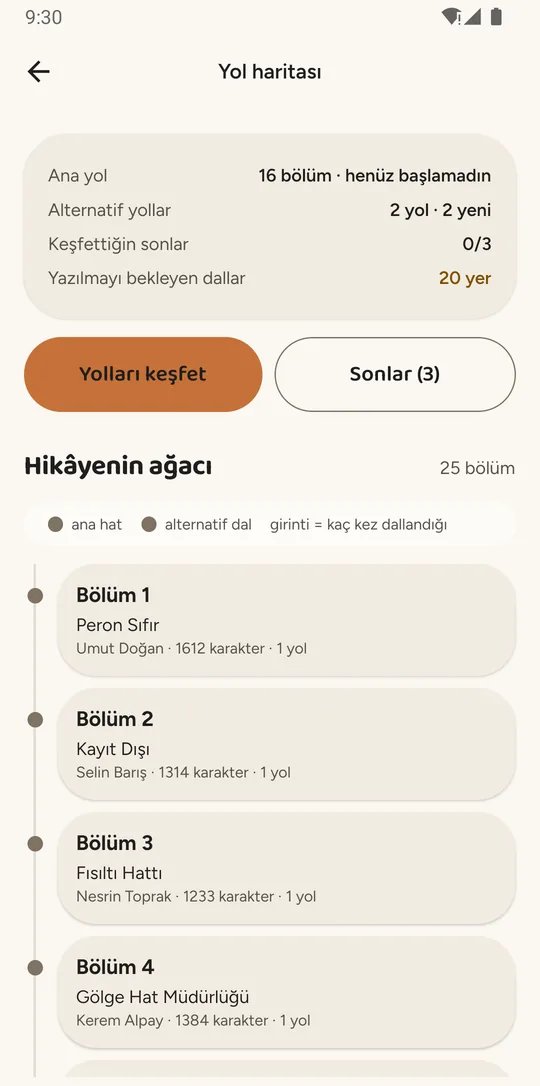
Usually, but not always. A branching story’s paths can merge again and arrive at a single ending, while a story with multiple endings has at least two paths that finish differently. In Story Circle branches never merge and every path that reaches the book’s target length is an ending, so each branch of a branching book runs to an ending of its own.
No, and assuming it does is one of the most expensive mistakes in the form. A fork is not the same thing as a chapter ending. Two or three well-placed forks will carry a whole book, while a choice at the end of every chapter produces a tree nobody can finish. Put a fork where the character has something real to lose, not at a fixed interval.
On paper, yes; merging is the strongest tool for keeping a branching story finishable. The condition is that the merge leaves a trace, so readers still feel which way they came. In Story Circle every chapter has exactly one parent, so branches do not merge; the branch interval and the maximum number of endings keep the tree in check instead.
No. Sibling branches do not know about each other: what happened in 2.1 did not happen in 2.2. A branch may build only on the chapters above it and on facts that hold everywhere in the book. Borrowing a detail from a sibling branch is the most common continuity error in multi-author branching stories.
An abandoned branch is a road that leads nowhere, and it hurts a book more than a missing branch would. There are two honest exits: close it with a short but definite ending, or leave it somewhere another writer can pick it up. In Story Circle, if your writing time runs out the chapter opens to everyone again and another writer can continue it; your draft stays with you.
You can, as long as two numbers are fixed up front: how many chapters a branch may run before it ends or rejoins, and how many paths a fork may open. With those limits in place, the rest can be discovered while writing. Without them, not planning does not make the book bigger; it makes it fall apart.
Paper goes a long way: a tree drawn on one sheet, a branch card for each branch and an ending inventory. Twine, a free open-source tool, is built for writing and linking branching passages on your own. Story Circle is a different kind of tool: it lets several writers write the branches of one book, with each open branch written by whoever starts it first.
Under one published chapter there can be several continuations at once: one published, one being written, one still open. Story Circle is in closed testing on Google Play; the public Android release is on November 1, 2026. The interface is in English and Turkish.
The main kinds of interactive fiction, a short history of the form, and the shapes a branching story can take.
The promise each fiction genre makes to the reader, subgenres and hybrids, and how choosing a genre changes what you write.
What fan fiction is and is not, the vocabulary of the form, where copyright draws the line, and staying consistent in someone else’s world.