 Story Circle
How to write a story for beginners
From want and obstacle to scenes, the first line, dialogue and revision: the steps of writing a short story from start to finish.
You create a character by starting from a want, not a list of traits. Decide what they concretely want in this story, what stands in the way and where they contradict themselves; then give them a distinct voice and put them in front of a hard choice. Readers know characters by their decisions, not their descriptions.
Last updated:
Eye color, star sign and favorite food come later, if at all. Below: seven steps worked through one example character, a fill-in character profile template, how a voice separates from every other voice, and the hardest part of writing with other people: continuing a character somebody else created.
In seven steps: want, obstacle, contradiction, voice, decisions, pressure and change. The first three get a character on their feet; the other four keep them on the page. Every example below uses the same character, Mara.
Write down what they want in this story, even in this scene. “To be happy” isn’t a want; “to keep this job” is. A concrete want tells you where the scene ends.
Example: Mara is a home care nurse. Her elderly patient’s son is about to let her go, and Mara wants to stay.
The weakest obstacle is a villain with bad intentions. The strongest is the character’s own habit, or another person with an equally reasonable want. Change the obstacle and you change the story.
Example: The obstacle is the patient herself: she doesn’t want Mara there, and won’t tell anyone why.
What makes a character memorable is two truths that don’t fit together. A contradiction isn’t a flaw, it’s tension, and the day that tension snaps you have a scene.
Example: Mara keeps every family’s secrets but can’t keep anything from her sister, who happens to live next door to this family.
Four dials set a voice: what they avoid, what units they measure the world in, what they call things, and the rhythm of their sentences. Don’t turn them all at once; one is enough.
Example: Mara tells time by medication: “We’ll talk after the nine o’clock pills.”
“She was meticulous” is an assertion, and readers forget assertions. Write the small decision that reveals the trait, and the reader draws the conclusion themselves and remembers it because they drew it.
Example: Before pouring the tea, Mara checks the bottom of the cup, and turns her back so no one sees her do it.
Supporting characters exist to make one side of the main character visible: someone in the same situation who acts differently, someone strong where they are weak, someone who pays for their decisions.
Example: Another nurse, who quit this same job months ago, turns Mara’s staying into a choice.
Something in the story has to change, but it doesn’t have to be the character. If the character does change, the change needs a trigger and a cost.
Example: Mara may not change at all; her refusal to leave may be what changes the patient’s son.
A practical test of whether you know a character: put them in an unfamiliar room, have someone ask them for something, and write what they do.
If you can write it without hesitating, the character exists. If you can’t, what’s missing isn’t information; it’s a want.
Keep a character profile to remember the character at a glance, not to predict everything in advance; ten questions that produce scenes beat fifty that produce a biography.
Most character sheets online ask about eye color, star sign and favorite food. A sheet like that produces a biography, while a story needs decisions: you can answer forty questions and still not know what your character says to a friend asking to borrow money. The template below is built from decision questions instead. The third column is filled in for Mara; copy the table and fill that column in for your own character.
| Field | Ask yourself | Example: Mara |
|---|---|---|
| Name and role | What is their job in the story: protagonist, sidekick, antagonist? | Mara, 41 · protagonist, home care nurse |
| Want | What do they concretely want in this story? | To keep her job |
| Deeper want | What sits underneath that concrete want? | To be seen as someone who can be trusted |
| Obstacle | Who or what stands in the way? | Her patient doesn’t want her and won’t say why |
| Contradiction | Which two truths about them don’t fit together? | Keeps everyone’s secrets; can’t keep any from her sister |
| Avoidance | What will they never do or say? | Never says “I don’t know”; says “I’ll look into it” |
| Unit of measure | What do they measure time, money or distance in? | Time, in medication rounds |
| Breaking point | What makes them break their own rule? | Someone blaming her sister |
| Cost | What do they lose if they get what they want? | Her sister’s trust |
| Change | By the end, do they change, or does the world around them? | The world around her: the patient’s son |
Fill in the first five rows before you start writing, and the rest as they turn up in scenes. A profile earns its keep in long books with several writers: one page recording how the character laughs, what makes them angry and which word they never use can be the only thing that keeps them consistent.
On Story Circle, the character guide has three fields per character: name, role in the story and a short description. Putting the want, obstacle and contradiction rows into that short description tells the next writers far more than eye color ever could.
If you delete the names from a dialogue and can still tell who is speaking, the voices are distinct; if you can’t, turn one of these four dials.
Every character has something they don’t do. One never apologizes and changes the subject instead; another answers questions with questions. Avoidance shows up in every scene, and readers learn it without noticing.
One person gives distance in minutes, another in miles. One thinks in salaries, another in day rates. It’s the cheapest detail there is for telling readers where someone comes from, and it needs no explanation.
One person says “died”, another “passed”, another “we lost her”. The moment you choose what a character calls something, you also choose how close they stand to it.
Length, repetition, how often they ask questions. One never finishes a sentence; another ends every one firmly. A difference in rhythm between two characters is enough; caricature isn’t needed.
One warning: accents and verbal tics are not voice. A regional accent or a catchphrase makes a character recognizable on page one and tiring by page three. Voice lives in what someone thinks is worth saying, not in how the words sound.
Don’t name the trait; write a small decision that reveals it. The reader draws the conclusion and remembers it because they drew it.
| Trait | Shown | Told |
|---|---|---|
| Meticulous | Checks the bottom of the cup before pouring, and turns her back so no one sees. | “She was meticulous.” |
| Loving | Every time he calls his mother, his first question is the same: did she take her pills? How she is comes third. | “Daniel loved his mother very much.” |
| Generous | Leaves the tip under the plate so nobody sees it. | “He was a generous man.” |
| Afraid | Pretends to wait for the elevator, then takes the stairs once everyone else is in. | “She was afraid of small spaces.” |
The second row carries extra information: Daniel doesn’t just love his mother, he loves her by checking on her. Showing a trait doesn’t only prove it; it gives it a shape. Four moments reveal a personality fastest:
A supporting character is pressure, not scenery: each one makes a side of the main character visible, and one that doesn’t has no place in the scene.
Someone in the same situation who acts differently. Their existence turns the main character’s choice into a real choice.
Someone strong exactly where the main character is weak. Often not an enemy but the closest friend, which is why it hurts.
The person who picks up the bill for the main character’s decisions. When a cost has a face, readers take it seriously.
Someone who notices the change. The most graceful way to show how far a character has come is the reaction of someone who hasn’t seen them in a long time.
One trap: the errand character, who walks into a scene only to hand the protagonist some information and wants nothing of their own. Readers sense it immediately. The fix is cheap: give them a small want too. And pace the cast: a first chapter crowded with new names wears readers out, so introduce a large cast a few at a time.
No: something in the story has to change, and it doesn’t have to be the character.
Believes something wrong for most of the story and learns otherwise at the end. What holds readers is not the change but the resistance: the character should fight the change until the last moment. The change needs a trigger and a cost.
Stays the same from start to finish and changes everyone around them. The less they bend, the more pressure they put on the world. To keep them from going flat, write one scene, and only one, where they are shaken.
A useful question: at the end, who is more different, the character or their world? In a book written chapter by chapter, don’t try to fit the whole arc into one chapter. In a single chapter a character takes one step at most: notices something, refuses something, or steps back once. Development shows up across the chapters.
Character analysis runs creation in reverse: you work back from the decisions on the page to the character’s want, obstacle and contradiction.
Base the analysis on decisions, not on description (“brave, jealous, kind-hearted”): a description is the author’s assertion, a decision is evidence. The same five questions are also the fastest way to get to know a character you inherit in a book written with others.
Interpret the character but don’t correct them: add information without canceling what exists, take their voice from earlier chapters, and leave the next writer a door when you make an irreversible move.
Don’t repair an inherited character to your own taste. Making them “better” erases the tension the previous writer built. Your job is to put them in a new situation.
A new past, a new fear, a new relationship all enrich the book. Overriding something already established breaks what readers have built. If you spot an inconsistency, use it in the scene instead of erasing it: why did the character act differently?
Before you write, read the character’s earlier lines: sentence length, what they call things, what they avoid. Five minutes of reading beats two pages written from memory.
A death, a betrayal, a breakup, a move to another city: these tie the next writer’s hands. We’re not saying don’t; we’re saying leave a door ajar when you do.
“Actually, it was all because of his father” solves a character, and a solved character shrinks. Keeping the mystery isn’t laziness; it’s material left for the next writer.
Having someone else write the character you created is the toughest test a character can face.
A well-built character is recognizable in another writer’s hands; one that only exists in your head falls apart the first time it changes hands.
The person who sets up the book defines the characters: they add them alongside the first chapter, the characters go into the book’s character guide, and every writer who joins later sees that guide while writing a chapter.
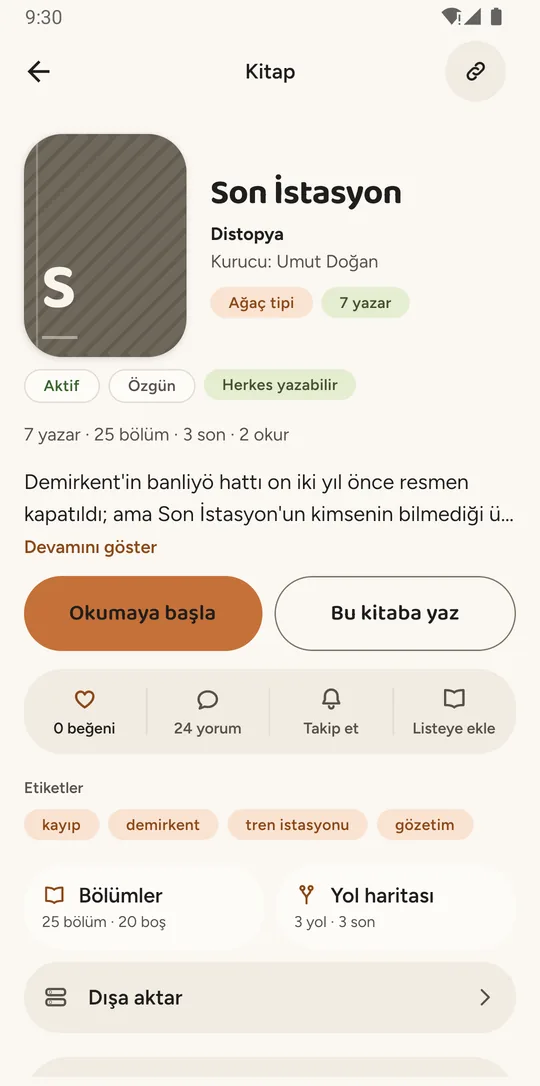
Story Circle is a mobile app where a book is written by a community rather than a single author. Characters belong to the book, not to individual chapters, so everyone writes the same people instead of their own private version. In practice:
The owner can also switch on the consecutive-author rule, so nobody can write directly under their own chapter and each character changes hands with every chapter. In branching books the same character can make two different decisions on two different paths, and readers choose which one to follow. Every submitted chapter goes through automatic content review before it is published; the full cycle is on how Story Circle works.
Story Circle is on Android, currently in closed testing on Google Play, with public release planned for November 1, 2026. The app is available in English and Turkish. The decisions you make when setting up a book are covered in how to start writing a book, and the ground rules for working with other writers in collaborative writing.
To test your character in a scene, the beginner’s guide on how to write a story covers scene building; to start from a character and work out a plot, see how to come up with story ideas.
With a want, not a history. Three things make a character writable: what they concretely want in this story, what stands in their way, and the contradiction they carry. Eye color, star sign and childhood memories come after that, and often never come up at all.
Not a fifty-question one, and those are often misleading: a sheet produces a biography, while a story needs decisions. What helps is a short character profile built from questions that produce scenes, such as want, obstacle, contradiction, avoidance and cost. Half of it gets filled in while you write, as things turn up on the page.
Three are essential: a concrete want, an obstacle and a contradiction. On top of those comes a distinct voice: what they avoid, what they measure time or money in, what they call things. Physical traits go in only when the story actually uses them.
Delete the names from a stretch of dialogue and see whether you can still tell who is speaking. If not, give one of them an avoidance (never apologizes, changes the subject instead) and the other a different measure: one gives distance in minutes, the other in miles. Accents and verbal tics are not voice; they are shortcuts, and they wear out fast.
No. Something in the story has to change, and it doesn’t have to be the character. An unchanging character changes the people around them, and what holds a reader is not the change itself but the resistance to it. If a character does change, it should cost them something; free transformation reads as unearned.
Interpret them; don’t correct them. You can add new information, but canceling existing information breaks what the reader has built. Read the character’s earlier lines before you write to get their measure, and if you make an irreversible move, such as a death, a betrayal or a departure, leave a door open for the next writer.
Yes, in two ways. The book owner can add characters to the character guide at any time. A writer working on a chapter can use “Suggest a character” in the editor to send a name, a role in the story and a short description; the suggestion is visible only to the owner and the writer until the owner publishes it, and then everyone sees it in the guide.
From want and obstacle to scenes, the first line, dialogue and revision: the steps of writing a short story from start to finish.
Ways to generate story ideas instead of waiting for them, a test for whether an idea is a story, and how to cut it to one sentence.
The different kinds of being stuck and a fix for each, what the standard tips really do, and when taking a break is the right call.