 Story Circle
How to write a story for beginners
From want and obstacle to scenes, the first line, dialogue and revision: the steps of writing a short story from start to finish.
You come up with story ideas by making them rather than waiting for them. What works: remove a rule and ask “what if”, collide two unrelated things, keep an observation notebook, bend a real event, start from what a character can’t bear, argue with a story you’ve read, or set a constraint. Then test the result in one sentence.
Last updated:
The difference between someone starting out and someone who has written for years is rarely the number of ideas. Both get roughly the same amount of material; what separates them is recognizing the good one when it turns up, and producing the next one when it doesn’t. Nothing below is a rule. They are procedures to run when you’re stuck, each with a short example.
Story ideas rarely arrive from outside: two separate things already in your memory end up side by side, and a tension appears in the gap.
So “no ideas are coming” usually hides one of two gaps. Either there is nothing new to combine, because you haven’t taken anything in for a while, or the parts are there and have never been put next to each other. The second gap is entirely yours to close, and every method below is a way of closing it on purpose.
The other common belief is that an idea should arrive whole, with a beginning, a middle and an end. Those arrive rarely and are usually the weakest, because a story whose ending you already know leaves you nothing to discover while writing it. A good starting idea is normally incomplete: a situation, a person, and a question you can’t answer yet.
Originality lives in the handling, not in the premise. Give ten writers the same sentence and you get ten different books.
They stop at different details, see through different eyes and leave different things unsaid. Dismissing an idea because “it’s been done” is the politest way of not starting.
These seven each take about twenty minutes, and none of them require you to feel creative. They all do the same job: they break the material you already have at one point.
Take a rule everyone treats as fixed and remove it. Then don’t look for the answer; look for the person who has to live inside the question. A good what-if changes a relationship, not a world.
Example: What if a school bus driver, after fifteen years on the same route, knew a child better than the child’s parents did?
Put two individually ordinary, concrete things in the same sentence. The idea isn’t in the overlap; it’s in the friction between them. “Loneliness” plus “technology” isn’t a collision, it’s two headings.
Example: A clerk in a city lost-and-found office + a suitcase nobody has come for in ten years.
Collect details, not ideas: one sentence a day, only what you actually saw or heard, no interpretation. Read it back after a month. Ideas come from two lines landing next to each other, and that only happens if the notebook exists.
Example: “Man on the bus, on the phone: fine, but don’t tell her. I’ll tell her.”
Take something that actually happened and bend it at one point. Bend the person carrying the event, not the event itself: reality gives you plausibility for free, and your job is to change who is holding it.
Example: A man anonymously returns money stolen thirty years ago. What if he isn’t the thief but the thief’s son, and his father doesn’t know?
Looking for “an interesting character” gets you nowhere. The useful question is what this person can’t bear; the story starts the day it happens to them. Building that person out is covered step by step in how to create a character.
Example: Someone who never lets themselves owe anybody, on the day they have to ask for a loan.
The moment you finish a book or a film thinking “that was the wrong decision”, you are holding an idea. That decision is the one your character wouldn’t make, and it tells you where your story begins.
Example: What if Little Red Riding Hood recognized the wolf at once, and gave him directions to her grandmother’s house anyway?
A blank page stalls ideas; a limit produces them. One place, one night, three people. A constraint turns “what should I write?” into “what could happen inside this?”, and the second question is always easier to answer.
Example: One night, one stairwell: two neighbors meet during a blackout, and one of them knows what the other has been hiding for years.
Yes, as half of an idea: a prompt or a generator hands you a situation, never a story.
The catch with prompt lists and random generators is that thousands of people start from the same line, and a generator can only recombine stock pieces. Use the prompt as one side of a collision: take the line, add something from your own notebook, then run it through the test in the next section. If you want an alternative to a generator, here are a few seeds made with the methods above:
None of these is a story yet. The next section tells you which one could become one.
An idea is a story when someone wants something, something stands in the way, and getting it will cost them; with only an interesting situation, you have a setting.
| Check | In a story | In a situation |
|---|---|---|
| Want | Someone wants something concrete. | Nobody wants anything; things just happen. |
| Obstacle | Something or someone is in the way. The sturdiest obstacle is another person with an equally reasonable want. | No obstacle, or pure chance. |
| Cost | Getting the thing means giving something up. | Winning is free. |
| Change | A relationship, a piece of knowledge or a decision is different at the end. | “And then what happens?” gets the answer “it continues”. |
| Open question | There is a question you can’t answer yet either. | The ending is fixed; writing turns into proving. |
Two sentences show the difference:
The second sentence contains a decision, a cost attached to it and an open question. What turns an idea into a story is usually not a detail but somebody deciding to act.
Fill in this shape: who wants what, but what stands in the way, and what will getting it cost. Whichever part you can’t fill is where the story is still empty.
If an idea won’t fit into one sentence, it isn’t an idea yet.
[Who] wants [what], but [obstacle]; getting it will cost [cost]. If you can’t build that sentence, you are holding an atmosphere, an image or a title: all worth keeping, none able to move on its own.
Applied to the lost-and-found idea: A clerk in a lost-and-found office wants to find the owner of a suitcase nobody has come for; but what’s inside says the owner doesn’t want to be found, and finding them means taking away someone’s right to disappear. The moment the sentence exists, so does the first scene: the clerk opening the suitcase for the first time.
The sentence isn’t there to tie you to a plan; it will change while you write, and it should. It’s there to show you the missing piece before you start. Once you have it, four quick tests:
Can you reduce the idea to one scene: who, where, wanting what, blocked by what? If not, it hasn’t come down far enough yet. A scene is writable; an idea isn’t.
Tell the idea to someone in one breath. Where you get bored is where a reader stops. The signal is in your own voice, not in their reaction.
Could you write the final sentence today? If so, the idea is closed, and walking a road with a fixed end turns writing into an errand. Knowing roughly where you’re heading is enough.
Write the idea down and leave it for two days. If you still want to go back to that sentence, it’s alive. On day one every idea looks bright.
A short story idea turns on a single moment; a novel idea has to carry the chain of decisions that moment sets off.
| Check | Short story idea | Novel idea |
|---|---|---|
| Core | One moment, one decision. | A decision that forces new decisions. |
| People | One person changes, two at most. | Several people’s wants collide. |
| Open question | Answered at the end, or left open on purpose. | Small questions close chapter by chapter; the big one waits. |
| Test | Can you draft it in one sitting? | Do the first three chapters each open a question of their own? |
If you can’t tell which one you have, start small and write it as a short story. A novel idea gives itself away with a second question the ending doesn’t answer. When it does outgrow a short story, the guide on how to start writing a book picks up from there.
Work out which problem you have first: if there’s genuinely nothing, change your input; if ideas come but none please you, lower the bar.
A shortage of ideas is usually a shortage of input. Go outside your genre entirely: a court ruling, a trade manual, the daily routine of a job you know nothing about.
This is the more common case. The problem is filtering, not production: you judge every idea the moment it appears. Write ten bad ideas and make being bad a requirement; the judging switches off and production comes back.
You can write a scene from even your weakest idea: two people, one room, one of them wanting something from the other. Ideas correct themselves surprisingly often while a scene is being written.
If every idea looks bad after a long stretch of writing, what changed is probably your yardstick. A few days off is maintenance, not escape. If it’s the writing itself that has stopped, see how to overcome writer’s block.
One habit worth having: never delete an unfinished idea, keep them all in one place. Abandoned ideas don’t die, they merge. Many good stories are two half-ideas, noted months apart, that finally land on the same page.
When you’ve stalled in the same place three times, when telling it excites you but writing it bores you, or when you know the ending and the road is just distance to cover.
Letting go isn’t deleting. Put the idea back in the notebook, date it and forget it. And there’s a third option people forget: some ideas won’t walk on their own but will walk in somebody else’s hands. One way of letting an idea go is sharing it.
On Story Circle the unit of writing is the chapter, not the book, so testing an idea means committing to one chapter rather than a whole novel.
An idea is untested until its first scene exists.
The fastest way to judge an idea is to shrink it to a chapter rather than a novel. A chapter is a job you can do; a novel is a decision.
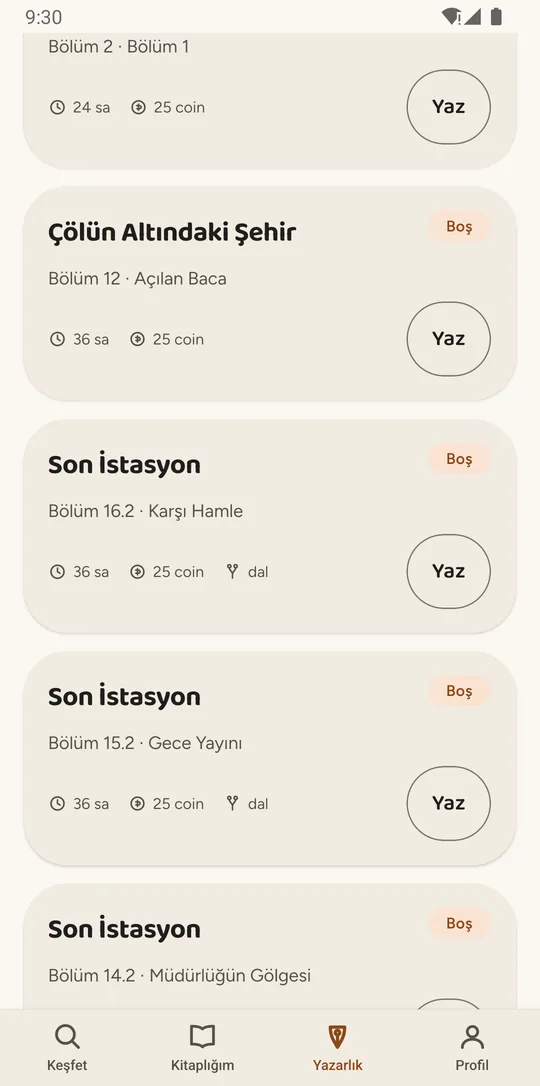
Story Circle is a mobile app where a book is written by a community rather than a single author. There are two ways to try an idea there:
Every submitted chapter goes through automatic content review before it’s published, and publishes on its own once it passes. In branching books several continuations can sit under the same chapter and readers choose their own path, so two readings of the same idea can stand side by side. The guide on how to write a branching story covers how those books are built.
Story Circle is on Android, currently in closed testing on Google Play, with public release planned for November 1, 2026. The app is available in English and Turkish. Every step from writing a chapter to publishing it is on how Story Circle works.
The craft of turning an idea into a scene (first lines, scene building, dialogue, chapter endings) continues in the beginner’s guide on how to write a story.
By making them rather than waiting for them. Remove a rule everyone treats as fixed and ask what if; put two unrelated, concrete things in one sentence; keep an observation notebook; bend a real event at one point; start from what a character can’t bear; argue with a decision in a story you read; or give yourself a constraint. Then test the idea in one sentence.
Stop trying to make the premise original and make the handling original. Give ten writers “a woman clears out her late mother’s house” and you get ten different books, because they stop at different details, see through different eyes and leave different things unsaid. The most reliable source of originality is your own material: an observation notebook, a job or place you know well, a decision in someone else’s story you disagree with.
Look for three things: someone wants something, something stands in the way, and getting it will cost them. With all three you have a story. With only an interesting situation you have a setting: intriguing, but it won’t move on its own.
A story idea is where the writer starts: someone who wants something, an obstacle and a cost. A theme is what the finished story ends up saying, and you usually find it by asking what changed and what the story suggests about that change. You don’t need a theme before you start; it often shows up while you write.
First work out which problem you have. If there is genuinely nothing, change your input: read outside your genre, learn the daily details of a job you know nothing about. If ideas come but none please you, lower the bar on purpose: write ten bad ideas and require them to be bad. What stops ideas is rarely emptiness; it is the obligation to be good.
An idea is untested until its first scene exists. On Story Circle the unit of writing is the chapter: you can set up your own book with a story premise, a first chapter and characters, or write an open chapter in someone else’s book. Every submitted chapter goes through automatic content review, publishes once it passes, and someone else writes what comes next.
From want and obstacle to scenes, the first line, dialogue and revision: the steps of writing a short story from start to finish.
Building a character from want, obstacle and contradiction, plus their voice, the decisions that define them and when they should change.
The different kinds of being stuck and a fix for each, what the standard tips really do, and when taking a break is the right call.